
A traumatic brain injury can affect many areas of everyday life. Depending on the injury, a person may experience changes in balance, cognition, vision, sleep, mobility, or other functions. Because every traumatic brain injury is different, the type of assistance a person needs can also vary.
For some people living with a permanent disability related to a traumatic brain injury, a specially trained service dog may provide practical assistance with specific challenges throughout the day.
At Guardian Angels Medical Service Dogs, we train each service dog individually based on the recipient’s needs. For recipients with traumatic brain injuries, tasks may include balance, mobility, retrieving objects, responding to certain medical events, and completing everyday activities.
Understanding what these dogs are trained to do can help individuals and families develop realistic expectations about working with a service dog.
How Can a Traumatic Brain Injury Affect Daily Life?
A traumatic brain injury, commonly called a TBI, can result from a blow or jolt to the head or body or from an object penetrating the skull. The effects depend on factors such as the injury’s location, cause, and severity.
Possible effects can include:
- Problems with balance or dizziness
- Seizures
- Changes in cognition or comprehension
- Sleep difficulties
- Headaches
- Changes in vision
- Mobility challenges
- Changes in mood or behavior
These are only examples. No two brain injuries are the same, which is important when considering whether a service dog may be appropriate.
There is no universal list of tasks for every person with a TBI. One recipient may benefit primarily from mobility assistance, while another may need help retrieving objects or responding to a medical event. Some recipients may have several needs that we can address through individually trained tasks.
That is why we train each service dog with the recipient’s needs in mind.
What Does a Service Dog for TBI Do?
A medical service dog is trained to perform specific tasks related to a recipient’s disability.
At Guardian Angels, we customize service dog training to each recipient’s needs. This is especially important for people with TBI because two people with the same diagnosis may experience very different limitations.
The dog’s purpose is not to perform every activity for the recipient. Instead, the dog is trained to assist with specific tasks that may otherwise be difficult because of the person’s disability.
Depending on the recipient, those tasks may include the following:
Providing Balance and Mobility Assistance
Balance problems and dizziness can occur following a brain injury. For recipients who experience these challenges, we may train a service dog to provide appropriate balance or mobility assistance.
Our dogs can be trained to help some recipients rise to a standing position, assist during certain transfers, and provide balance support while the recipient stands or walks. We may also use specialized harnesses when appropriate for the recipient and the task.
This type of training is designed to assist with balance. It does not mean the dog supports the recipient’s full body weight. For someone whose disability affects balance or mobility, these trained tasks can provide practical assistance with everyday movement.
Retrieving Dropped or Needed Items
Dropping a phone, keys, or another everyday item can be a bigger challenge for someone who experiences dizziness, balance limitations, or difficulty bending down and standing back up.
Retrieval is one practical task our service dogs may be trained to perform. A dog may retrieve a dropped object or bring the recipient an item such as a phone. This can reduce the need for the recipient to bend, reach, or rely on another person each time they need to pick up an item.
The task itself may be simple, but it can help address a specific limitation related to the recipient’s disability.
Helping With Doors and Lights
Our service dogs may also be trained to assist with parts of the recipient’s physical environment. Depending on the recipient’s needs, that can include opening or closing doors and turning lights on or off.
These tasks may be useful when reaching, bending, standing, or moving through a space is difficult. Not every recipient will need this type of assistance. The tasks selected for a service dog depend on the needs of the person the dog is trained to assist.
Supporting Transfers and Getting Up
Some recipients with TBI-related physical limitations may have difficulty moving between positions. For appropriate recipients, our service dogs may be trained to assist during certain transfers, help with rising to a standing position, or assist when the recipient is getting back up after a fall.
These tasks require specialized training and must match the needs of both the recipient and the dog. This is one reason individualized training is an important part of developing a service dog team.
Alerting Before Certain Medical Events
Some traumatic brain injuries can be associated with seizures. For recipients who experience seizures, our service dogs may be trained to provide an alert that allows the recipient to take appropriate safety precautions.
An alert provides the recipient with information that may help them respond to the situation. A service dog does not treat the underlying medical condition and is not a replacement for medical care, medication, rehabilitation, or other treatment recommended by healthcare professionals.
Responding to Nightmares and Sleep Disruptions
Sleep difficulties can also occur following a brain injury. For some recipients, service dog training may include responding to nightmares or sleep disruptions when appropriate for the individual’s needs.
This type of training will not apply to everyone with a TBI. For example, a recipient whose primary challenges involve balance or mobility may require a different set of tasks.
The recipient’s individual needs help determine the dog’s training.
How Service Dogs Can Support a More Consistent Routine
Life after a traumatic brain injury may require changes to familiar routines.
A trained service dog can become part of those routines through predictable and repeatable tasks.
For example, a recipient may cue the dog to retrieve a dropped object, assist with a door, provide appropriate balance assistance, or perform another trained task. Our dogs may also assist with memory-related daily activities when that type of training is appropriate.
The service dog and recipient learn to work together as a team, with the dog performing tasks related to that recipient’s disability.
A service dog does not eliminate every challenge associated with TBI. Recipients may continue to need medical treatment, rehabilitation, assistive devices, family support, or other resources. The service dog has a specific role within that larger support system.
Supporting Safety Through Trained Tasks
Some people with TBI consider medical service dogs because their disability creates safety concerns during everyday activities.
Balance difficulties, falls, seizures, and other symptoms may create situations where a trained response is useful. A service dog may be trained to retrieve a phone, provide an alert, assist with a mobility task, or perform another specific response.
However, a service dog cannot prevent every fall, predict every medical event, or remove all risk from daily life.
Its role is to perform trained tasks related to the recipient’s disability. These tasks can support the recipient, but they do not replace appropriate healthcare, emergency planning, mobility devices, or other safety measures recommended for the individual.
Supporting Independence Through Everyday Tasks
Independence after a traumatic brain injury does not necessarily mean completing every activity without assistance.
For some recipients, it means having another way to complete everyday tasks when a disability creates an obstacle.
Depending on the recipient’s needs:
- A dropped object may be retrieved.
- A door may open or close.
- A light may be turned on or off.
- A trained dog may provide appropriate balance assistance.
- A recipient with certain medical needs may receive a trained alert.
These tasks are selected and trained based on the recipient’s individual needs. Together, they can help reduce some of the barriers a person with a permanent disability may encounter during everyday routines.
Every TBI Service Dog Team Is Different
No standard set of tasks applies to every TBI service dog.
One recipient may experience significant balance problems but no seizures. Another may experience seizures without needing mobility support. Another recipient may have several disability-related needs that affect the tasks the dog is trained to perform.
At Guardian Angels, we train our medical service dogs to meet each recipient’s specific needs rather than assigning the same tasks to everyone with a particular diagnosis.
The service dog and recipient must ultimately be able to work together as a team.
To learn more, read our article on How Service Dogs Can Assist Recipients with a Traumatic Brain Injury.
Is a Medical Service Dog Right for Someone With a TBI?
Having a traumatic brain injury does not automatically mean a service dog is the appropriate option.
A more useful question is whether the person has a permanent disability and specific needs that an individually trained medical service dog can address.
At Guardian Angels Medical Service Dogs, we work with veterans and other individuals with permanent disabilities, including people affected by traumatic brain injury, seizure disorders, mobility issues, PTSD, and other conditions. We raise, train, and pair medical service dogs with qualified recipients.
Someone considering a service dog may want to consider the specific barriers they face in everyday life.
- What activities are difficult because of the disability?
- Are balance or mobility challenges affecting everyday tasks?
- Would retrieving objects reduce difficult bending or movement?
- Are there other disability-related needs that a trained task could address?
These questions can help clarify the type of assistance a service dog may need to provide.
Learn More About Medical Service Dogs for TBI
A traumatic brain injury can affect each person differently, so there is no single service dog task list that applies to every recipient.
We train our service dogs to meet the needs of the people they are paired with.
For an appropriate recipient, that training may include retrieving items, helping with doors and lights, providing mobility assistance, responding to certain medical events, or performing other disability-related tasks.
Guardian Angels Medical Service Dogs has trained and paired medical service dogs with veterans and others with permanent disabilities since 2010.
If you or someone you know is living with a permanent disability related to a traumatic brain injury and would like to learn whether a medical service dog may be an appropriate option, contact Guardian Angels Medical Service Dogs or begin the application inquiry process to learn more about eligibility and next steps.
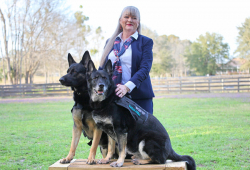
Mrs. Borden’s expertise and accomplishments are acknowledged by numerous national awards from various industries and agencies including the 2018 Corporate Pet Industry Woman of the Year and multiple awards for her organization’s work in mental health and suicide prevention.
She is frequently requested as a Keynote Speaker, and as an Industry Consultant to teach service dog laws to judicial systems, attorneys, and businesses, and to assist in service dog bills in multiple states that were passed into law. In 2020, she started an Institute for Higher Learning and the Borden Veterinary Hospital. Additionally, she has written and teaches college-accredited/VA-approved apprenticeship courses on dog training and service dog training.
- Service Dogs in Restaurants and Retail Stores: Public Access Best Practices - October 15, 2026
- Suicide Prevention Month: How Service Dog Teams Support Connection, Routine, and More! - September 26, 2026
- Final Call for Tickets: Guardian Angels’ Pawtumn Bark-A-Que Is This Saturday - September 29, 2026