
September is Suicide Prevention Month, a time to raise awareness, encourage meaningful conversations, and remind people that reaching out for support matters.
At Guardian Angels Medical Service Dogs, this month holds particular meaning for us because so many of the veterans and first responders we serve live with challenges that may not always be visible to others. PTSD and other permanent disabilities can affect many parts of daily life, from maintaining routines to participating in activities and staying connected with the people around them.
For qualifying recipients, a medical service dog can become an important part of daily life. We train and pair each service dog with an individual recipient, creating a team built around that recipient’s specific disability-related needs.
Those pairings can have a significant impact. Guardian Angels Medical Service Dogs reports a 0% recipient suicide rate among its service dog teams and an average 59% decrease in major symptoms, including anxiety, depression, and irritability, after one year with a dog.
It’s important to know that a service dog is not a replacement for mental health treatment, crisis support, or a personal suicide safety plan, but plays a significant role in the daily life of a recipient.
A mental health professional may provide care during appointments or crises. At the same time, a service dog can be physically present throughout much of the recipient’s everyday life, including during periods of anxiety, nighttime disturbances, and other disability-related challenges. Trained tasks and the routines of working as a team may therefore provide support at times when another person is not physically present.
Connection Can Begin With Everyday Moments
When someone is managing PTSD or another permanent disability, everyday situations can sometimes become more difficult. Going to an appointment, visiting a public place, spending time with family, or participating in community activities may require more planning and effort than others realize.
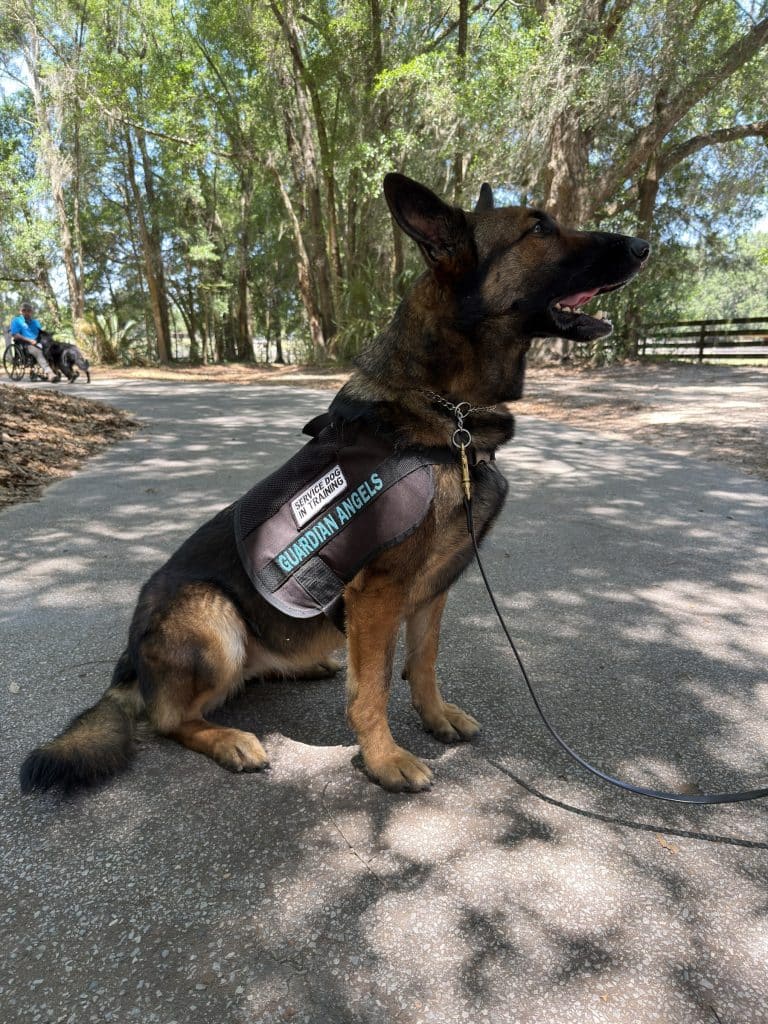
Our medical service dogs are individually trained to perform specific tasks for their recipients. Depending on a person’s disability-related needs, those tasks may include grounding during anxiety or panic, responding during a flashback, creating additional personal space in public, or waking a recipient from a nightmare.
These trained tasks do not replace relationships with family members, friends, peers, medical providers, or mental health professionals. They may help a recipient address a specific challenge that has made participation in everyday life more difficult. For some teams, that can mean being better able to attend an appointment, run an errand, join a family activity, or spend time in the community.
Connection doesn’t always mean a large social event. Sometimes it begins with being able to take part in ordinary moments again. We have discussed the importance of awareness and support during Suicide Prevention Month in previous years, including in our article about how Guardian Angels is working to make a difference.
Routine Is Part of Working as a Team
A Guardian Angels service dog and recipient work together as a team, and that relationship requires consistency.
Recipients take an active role in caring for their service dogs and maintaining the skills they have learned together. Daily life may include feeding, exercise, training reinforcement, grooming, public outings, and other regular responsibilities. For some people, these recurring responsibilities can add structure to the day.
Depending on the recipient’s individual needs, a service dog may also be trained to perform specific tasks connected to an established routine. The exact tasks vary because every recipient is different, and every team trains to the individual’s disability-related needs.
Routine should not be viewed as a treatment for suicidal thoughts or as a guarantee that a crisis will not occur. It is one part of the day-to-day working relationship between a recipient and a trained medical service dog.
At Guardian Angels, we believe it is important to recognize both sides of that relationship. Our dogs receive extensive training, but recipients also learn how to communicate with their dogs, reinforce trained behaviors, and continue developing their skills as a team.
Sleep and the Body’s Stress Response Matter, Too
PTSD can affect more than a person’s thoughts and emotions. It can also affect sleep and the body’s physiological stress response.
Research from Purdue University’s Center for the Human-Animal Bond examined salivary cortisol in veterans with PTSD who had a service dog compared with veterans who were waiting to receive one. Cortisol is involved in the body’s stress-response system.
Veterans with service dogs showed a significantly stronger, healthier cortisol awakening response than those on the waitlist. Because PTSD can be associated with a blunted cortisol response after waking, researchers suggested that this difference may represent a more typical or healthier physiological response. Veterans with service dogs also reported less anxiety, anger, sleep disturbance, and PTSD severity.
Sleep itself is especially important when discussing veteran mental health and suicide prevention. A seven-year study involving 2,059 U.S. military veterans found that poor self-rated sleep quality was associated with a more than 60% greater risk of developing suicidal ideation, even after researchers adjusted for established risk factors such as major depressive disorder.
For some recipients, nighttime tasks are therefore an important part of their service dog’s role. A service dog may be trained to wake a recipient from a nightmare or respond to other disability-related nighttime disturbances.
Recent research involving 155 veterans with PTSD found that service dog partnerships were associated with better self-reported sleep quality, less sleep disturbance, less fear of sleep, and lower odds of nightmares after three months.
Better sleep does not eliminate suicide risk, but the relationship between sleep problems and suicidal ideation makes this an important part of the broader conversation.
A Service Dog Is Only Part of the Plan
During Suicide Prevention Month, it is especially important to be clear about what safety planning means while also recognizing the unique role a service dog can play.
A suicide safety plan is an individualized plan designed to help a person recognize when a crisis may be developing and identify specific steps and resources they can turn to. The 988 Suicide & Crisis Lifeline recommends identifying warning signs, personal coping strategies, supportive people and places, people who can be asked directly for help, professionals or agencies to contact, and steps for reducing risks in the person’s environment. A medical service dog does not replace those resources, but that does not make the dog’s role insignificant.
Professional care and a trained service dog serve different purposes. Mental health professionals provide expertise, treatment, assessment, and crisis care. A service dog may be physically present with the recipient throughout much of the day and night and can perform trained disability-related tasks when symptoms occur.
That ongoing presence can matter because a suicidal crisis is not always obvious to the people around someone. The U.S. Department of Veterans Affairs notes that many veterans do not show signs of an urge to harm themselves before doing so. In contrast, others may display warning signs that can be difficult for friends or family members to recognize.
For someone already part of a trained service dog team, a qualified mental health professional may discuss routines and disability-related tasks as part of developing an individual safety plan. The plan should remain centered on the recipient’s individual needs and appropriate resources, while recognizing that the service dog may be one of the supports present in everyday life.
A service dog should not be expected to predict or independently prevent every suicide crisis. However, trained tasks may help address disability-related symptoms when they occur, including during times when another person may not know the recipient is struggling.
Trained Tasks Address Individual Needs
One of the most important things to understand about medical service dogs is that their work is individualized. A task that is appropriate for one recipient may not be necessary for another. We train our medical service dogs to meet the specific disability-related needs of the person they will work with.
For recipients with PTSD-related needs, trained tasks may include grounding during periods of anxiety or panic, responding during flashbacks, waking a recipient from nightmares, interrupting certain behaviors, or positioning themselves to create additional personal space.
These tasks can be especially meaningful because they can occur in the moment. A recipient does not necessarily need to wait until the next appointment, or until another person recognizes something is wrong, before the dog performs a trained task.
Creating personal space is sometimes called shielding. This is a positioning task. Do not confuse it with protection work or interpret it as the dog providing physical protection. A medical service dog’s task is to respond to a specific disability-related need.
This individualized approach is one reason we refer to the service dog and recipient as a team. The two learn to work together, and the recipient remains an active participant in maintaining that working relationship.
Service Dogs Are One Part of a Larger Support System
Mental health and suicide prevention are complex. No single resource can meet every person’s needs.
For a veteran or first responder, a broader support system may include mental health professionals, physicians, family members, fellow veterans or first responders, peer-support resources, community organizations, crisis services, and other sources of care. For an eligible recipient, a medical service dog may also become an especially consistent part of daily life within that larger network.
The distinction is not about choosing one type of support over another. Different resources serve different purposes.
Our service dogs are trained to perform meaningful tasks for recipients with permanent disabilities. They can be present during everyday situations when a therapist, physician, family member, or peer may not be. Professional care, trusted relationships, and crisis services provide other forms of support that a service dog cannot.
Recognizing those complementary roles creates a more complete picture of the support that may be available to someone living with PTSD or another permanent disability. Suicide Prevention Month allows all of us to talk more openly about available support and to remind veterans, first responders, families, and communities that asking for help should never be viewed as weakness.
We have shared more about this commitment in our previous article on Guardian Angels Medical Service Dogs and National Suicide Prevention Month.
Supporting Our Veterans and First Responders
Veterans and first responders spend their careers serving others, often facing experiences many people never have to.
When someone is struggling afterward, there is rarely one simple answer. At Guardian Angels Medical Service Dogs, our role is specific. We train and pair medical service dogs with qualified recipients with permanent disabilities. We then help each recipient learn how to work with their service dog so the two can function successfully as a team.
That team may become part of a recipient’s everyday routine and may perform tasks that make certain disability-related challenges more manageable.
At the same time, we encourage a broader view of support. Medical care, mental health treatment, trusted relationships, community resources, crisis services, and trained medical service dogs can each play different roles.
Recognizing those roles helps create a more informed and compassionate conversation about mental health, and about the meaningful difference a properly trained medical service dog can make in a recipient’s everyday life.
What to Do If You or Someone You Know Needs Help
Suicide Prevention Month is about awareness, but awareness is most useful when people also know where they can turn.
If you or someone you know is experiencing a suicidal, mental health, or substance use crisis, you can call or text 988 to connect with the 988 Suicide & Crisis Lifeline.
Veterans, service members, and those concerned about them can contact the Veterans Crisis Line by dialing 988, then pressing 1, or by texting 838255. The service is free, confidential, available 24 hours a day, and does not require enrollment in VA benefits or health care.
Learn More About Medical Service Dogs
Reaching out can be one step toward connecting with the people and resources that can help. At Guardian Angels Medical Service Dogs, we will continue doing our part by educating our communities, supporting our service dog teams, and helping people better understand the role a properly trained medical service dog can play in the life of an eligible recipient.
For the veterans, first responders, and other qualified recipients we serve, that role can include support during anxiety or panic, nighttime disturbances, flashbacks, public outings, and other disability-related challenges throughout everyday life.
Veterans and first responders interested in learning more are invited to explore Guardian Angels Medical Service Dogs, learn more about our impact, and review our service dog application process.
References
- Purdue-affiliated cortisol study: Rodriguez et al., The effect of a service dog on salivary cortisol awakening response in a military population with PTSD. View the cortisol study on PubMed
- Purdue summary of the cortisol/service-dog research: Purdue University research summary
- Veteran sleep and suicidal ideation study: McCarthy et al., seven-year prospective study of 2,059 U.S. military veterans. View the sleep and suicidal ideation study on PubMed
- Service dogs and sleep study: study of 155 veterans with PTSD examining sleep quality, sleep disturbance, fear of sleep, nightmares, and objective sleep measures. View the service-dog sleep study on PubMed
- VA information on warning signs: supports the statement that many Veterans may not show obvious signs before harming themselves. VA Veteran Suicide Prevention guidance
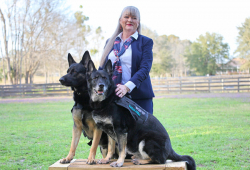
Mrs. Borden’s expertise and accomplishments are acknowledged by numerous national awards from various industries and agencies including the 2018 Corporate Pet Industry Woman of the Year and multiple awards for her organization’s work in mental health and suicide prevention.
She is frequently requested as a Keynote Speaker, and as an Industry Consultant to teach service dog laws to judicial systems, attorneys, and businesses, and to assist in service dog bills in multiple states that were passed into law. In 2020, she started an Institute for Higher Learning and the Borden Veterinary Hospital. Additionally, she has written and teaches college-accredited/VA-approved apprenticeship courses on dog training and service dog training.
- Suicide Prevention Month: How Service Dog Teams Support Connection, Routine, and More! - September 26, 2026
- Final Call for Tickets: Guardian Angels’ Pawtumn Bark-A-Que Is This Saturday - September 29, 2026
- Service Dogs for TBI: Practical Tasks That Support Routine, Safety, and Independence - September 4, 2026